
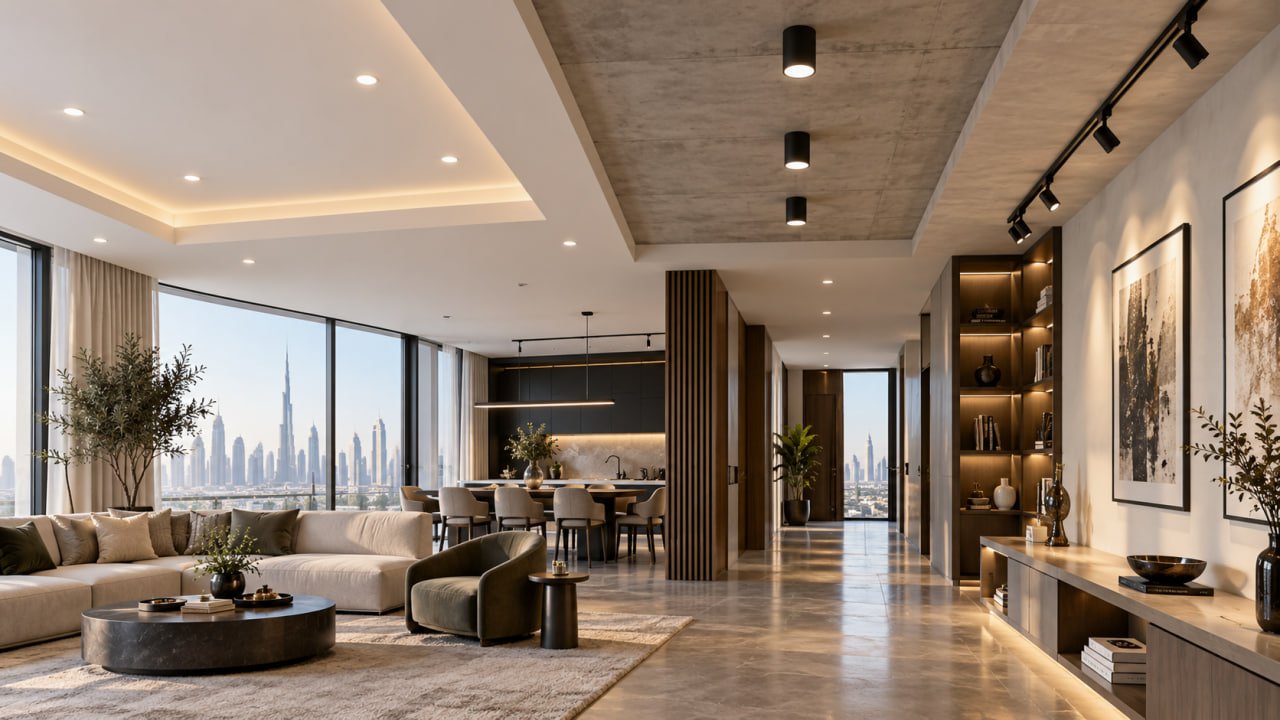
Recessed vs Surface vs Track Lighting: Right Choice for Your Ceiling
A recessed downlight may look cleaner than a surface fitting. Track lighting may give a designer much more freedom. Neither advantage matters if the ceiling cannot accommodate the system properly.
For a Dubai apartment, villa, shop, office or hospitality fit-out, start with the ceiling construction rather than the luminaire catalogue. Is there a gypsum false ceiling? A concrete structural slab? A suspended grid? An exposed soffit? How much space exists above the finished ceiling, and can somebody reach the driver later?
Those answers narrow the choice quickly.
As a working rule:
- Gypsum or suspended ceilings with usable void space: recessed lighting is usually practical.
- Concrete ceilings without a false ceiling: surface-mounted fittings or track are normally the more practical retrofit options.
- Retail, galleries, showrooms or rooms likely to change layout: track lighting deserves serious consideration.
- Low ceilings: recessed or low-profile surface fixtures usually create less visual clutter than projecting spotlights.
- Exposed architectural ceilings: surface or suspended track generally works with the construction rather than trying to conceal it.
That is only the first filter. The mounting depth, electrical feed, driver location and lighting task still have to agree with the ceiling.
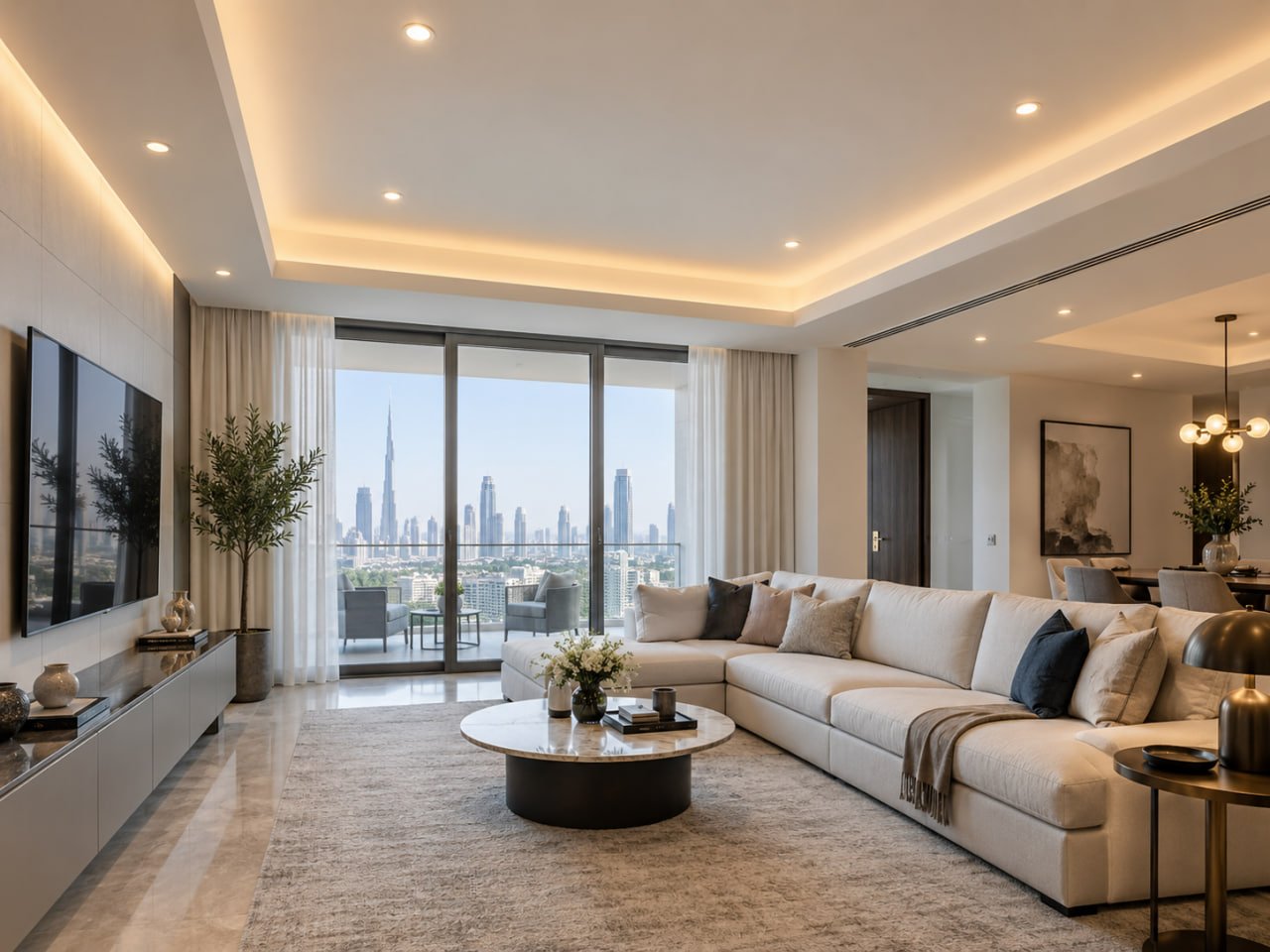
Start with what is actually above the paint
Two ceilings that look identical from the room can demand completely different lighting.
A gypsum board ceiling may have enough space behind it for a recessed fitting, but the cavity could already contain air-conditioning ducts, pipes, cable trays, fire-alarm devices or structural framing. A concrete slab, meanwhile, does not provide the cavity that an ordinary recessed downlight expects unless recesses were designed into the construction or a secondary ceiling is added.
Manufacturers therefore specify much more than the visible diameter of a recessed light. Installation documents commonly define the ceiling cut-out, permissible ceiling thickness, recess depth and free space required around the fitting or driver. Signify installation documentation, for example, shows specific cavity clearances for an individual recessed downlight; those dimensions apply to that product rather than to recessed lighting universally. ERCO similarly tells designers to obtain the required ceiling cut-out and recess depth from the individual luminaire data sheet.
That leads to a useful specification habit: never approve a recessed light from the front-view dimensions alone.
Check its section drawing.
In practice, one of the first things worth comparing is the available ceiling void against the complete fitting assembly — luminaire, driver, cable bend and any clearance stated by the manufacturer. A 40 mm-deep visible fitting does not automatically mean that 40 mm of ceiling space is enough.
Access matters too. An inexpensive fitting becomes inconvenient if the only way to replace its driver later is to damage finished gypsum.
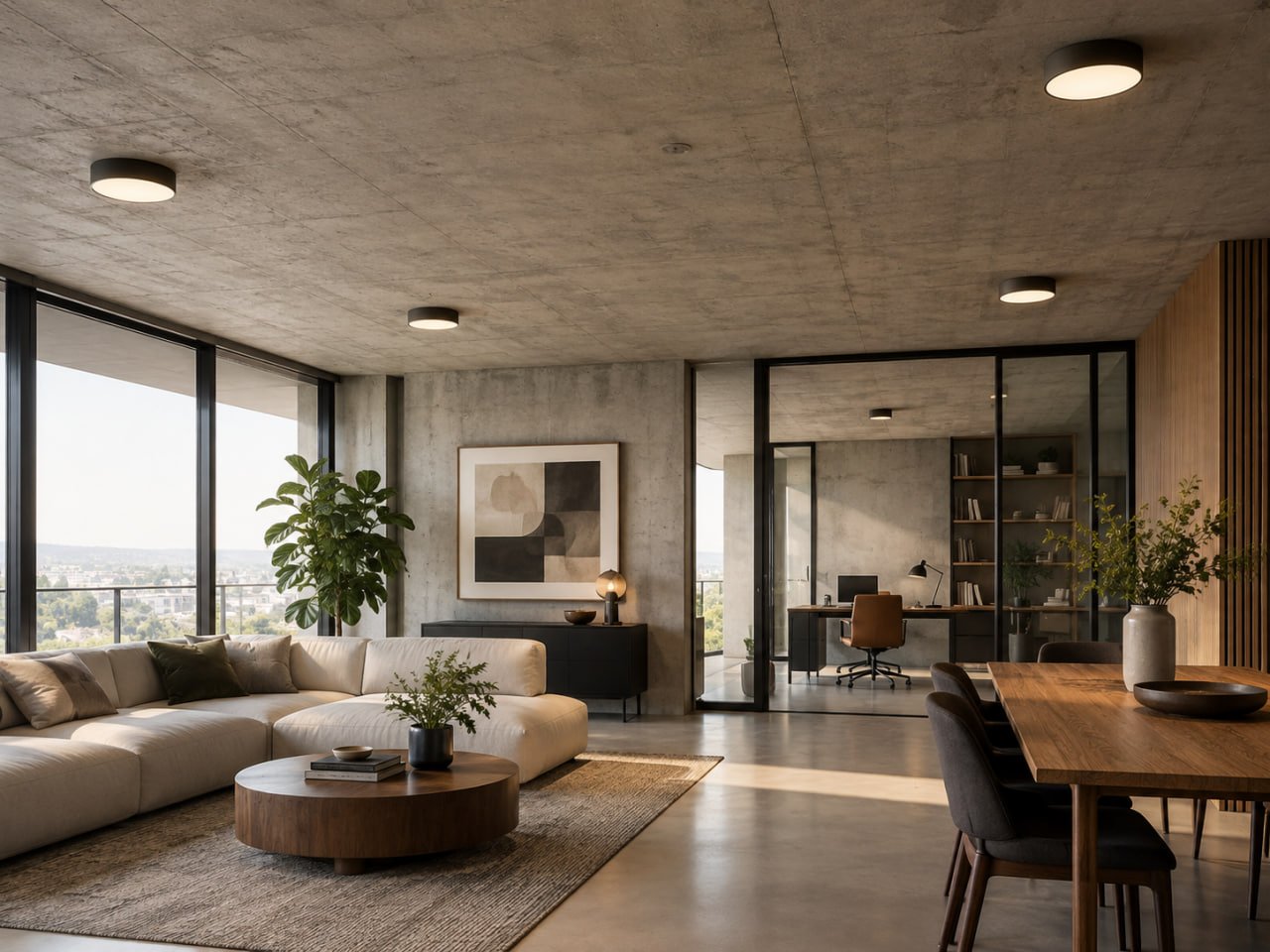
Concrete slab? Surface-mounted lighting is often the cleaner decision
A common renovation mistake is treating recessed lighting as the default and then constructing a new false ceiling solely to accommodate it.
Sometimes that is justified. Often it is not.
With an existing concrete ceiling, a surface-mounted luminaire keeps the lighting equipment below the slab. That can avoid the substantial ceiling alteration required to create conventional recessed positions. Wiring still has to be routed properly, and the fixture still requires an appropriate fixing method; “surface-mounted” does not mean “no installation work.”
For a room where the lighting positions are unlikely to move, surface fittings can be particularly straightforward: corridors, utility spaces, bedrooms with a fixed furniture plan, circulation zones and general office areas are examples where a carefully selected surface downlight or linear fixture can do the job without introducing a full track network.
The main question then becomes visual scale. A thick cylindrical fitting on a low ceiling can dominate the room. A flatter fixture can sit much more quietly against the slab.
There is another reason to check the product rather than specifying by appearance. Heat management differs between products. Recessed luminaires release heat into a cavity; surface fittings operate in another mounting condition. Installation instructions and rated ambient conditions therefore matter more than the generic label “LED.
For Dubai projects specifically, DEWA’s electrical installation regulations apply to electrical installations within premises in the Emirate and require electrical equipment and accessories to be suitable for the intended purpose and Dubai climatic conditions. That does not mean every ceiling void reaches an unsafe temperature, but it does mean the luminaire and driver ratings should be checked rather than assumed, particularly around non-conditioned or warm service spaces.
Track lighting is less about the ceiling and more about future change
Track becomes attractive when the question is not only Where do I need light now? but Where might I need it later?
A spotlight fixed permanently over today’s furniture arrangement may be pointing at empty floor after the room is rearranged. A track-mounted fixture can often be repositioned or replaced without moving the electrical point itself.
That has obvious value in retail. Merchandise moves. Displays change. Artwork changes. Restaurant tables and decorative features may be revised during refurbishment. Residential interiors can benefit too, particularly living rooms containing artwork, shelving or several functional zones.
There is also a misconception worth clearing up: track lighting does not automatically mean a bulky rail screwed onto the finished ceiling.
Professional track families may be surface-mounted, recessed or suspended. Current ERCO documentation, for example, provides all three mounting arrangements, while the luminaires themselves can be moved or replaced along the system.
That distinction is useful during new construction. If the architect wants the adaptability of track without a visible surface profile, a recessed track can be coordinated into the gypsum detail before the ceiling closes. If the project already has a concrete slab and minimal appetite for ceiling work, surface track may be the more rational route.
Magnetic low-voltage track adds another option, but system compatibility needs more attention than many buyers expect. The fixture, track, power supply, adapters and controls belong to an electrical system, not a collection of parts that can automatically be mixed because they share a similar shape. ORIX’s own magnetic lighting guidance, for example, specifies checking mechanical and electrical compatibility between the track, fixture, power supply, driver and control equipment before installation.
A question people actually ask: “Can I install recessed lights in a concrete ceiling?”
This comes up repeatedly in real lighting and renovation discussions: someone has a concrete apartment ceiling, dislikes the existing lighting and wants recessed downlights without losing ceiling height. Recent homeowner discussions still ask almost exactly that question.
For an existing structural concrete slab, the sensible starting assumption is no conventional recessed installation until the construction has been checked.
Do not treat the slab like plasterboard and start cutting holes because a downlight needs them. Structural concrete, reinforcement, embedded services and building restrictions can all affect what alterations are acceptable.
The practical alternatives are usually surface fittings, surface track, pendant lighting from approved points, or constructing a secondary ceiling where the project genuinely benefits from one.
A new concrete structure is different. Recesses, housings and electrical routes may be incorporated at the design stage if the structural, electrical and architectural teams coordinate them before casting. That is a planned construction detail, not the same thing as retrofitting a hole into an existing slab.
So the answer to the question is not really “recessed lighting cannot be used with concrete.” It is: concrete needs a different design strategy from a lightweight suspended ceiling.

Gypsum ceilings make recessed lighting easier — not automatic
Having a false ceiling removes one major obstacle, but it does not settle the specification.
Before buying the fittings, confirm the actual cut-out size and recess depth. Then check what occupies the same ceiling zone. On commercial fit-outs especially, the architectural reflected ceiling plan can become crowded once diffusers, sprinklers, smoke detectors, access panels, speakers and lights are coordinated.
Positioning should therefore be confirmed before contractors cut finished boards.
There is also a difference between enough space to push the fitting into the ceiling and enough space to install it according to its instructions. Manufacturer guidance can require additional space for the driver, cabling, heat dissipation or insertion angle. Professional lighting references specifically advise checking minimum recess dimensions and other mounting details rather than assuming that the physical fixture envelope is sufficient.
One professional observation is particularly useful here: if the ceiling contractor is asking for the downlight cut-out before the exact fitting has been approved, the sequence is backwards. Approve the luminaire and its current technical drawing first, then cut the ceiling.
That avoids oversized openings, improvised trim rings and last-minute substitution.
Don’t choose between the three systems until the lighting job is clear
Ceiling construction decides what is practical. It does not decide what produces useful light.
A fixed recessed downlight makes sense for predictable downward illumination. Surface fixtures can perform the same broad function where recessing is undesirable. Track is strongest when aiming, repositioning or combining different types of light matters.
That difference becomes obvious in a shop. A regular grid of recessed lights can provide excellent general illumination yet do a poor job of following changing displays. Track spots can follow merchandise much more easily.
A residential kitchen presents another case. Fixed task lighting over permanent counters may not need track at all. In the connected living area, adjustable lighting for artwork and furniture may justify it.
Mixing systems is therefore completely reasonable. Recessed lights can provide quiet general illumination while a short track handles artwork. Surface linear lighting may illuminate a circulation route while magnetic modules deal with a feature wall.
There is no technical prize for making every luminaire in the project use the same mounting method.

What should be confirmed before the order is released?
By the time a quotation becomes a purchase order, the specification should contain more than wattage and colour temperature.
Confirm the ceiling type, fixture mounting method, cut-out where applicable, recess depth, driver or power-supply location, required access, fixing arrangement and control method. For track, confirm the exact track family and adapter compatibility as well as the system load. Where dimming or smart controls are expected, the driver and control protocol need to agree with that requirement before products arrive on site.
For Dubai work, the electrical design and installation also need to follow the requirements applicable to the specific premises and project. DEWA maintains its regulations and related circulars, including material connected with the Dubai Building Code; landlord, development, fit-out or other authority requirements may also apply depending on the building and project scope.
That is why selecting a ceiling light only from a catalogue image tends to create trouble. A proper lighting schedule connects the luminaire to the ceiling detail, electrical system and intended lighting effect.
For projects where those conditions are not yet clear, a site review before final product selection is usually more useful than comparing another ten fixture designs. ORIX states that its UAE lighting services include lighting design, technical calculations, site visits, product selection and project coordination, which fits this type of ceiling-dependent specification work.
sources :