
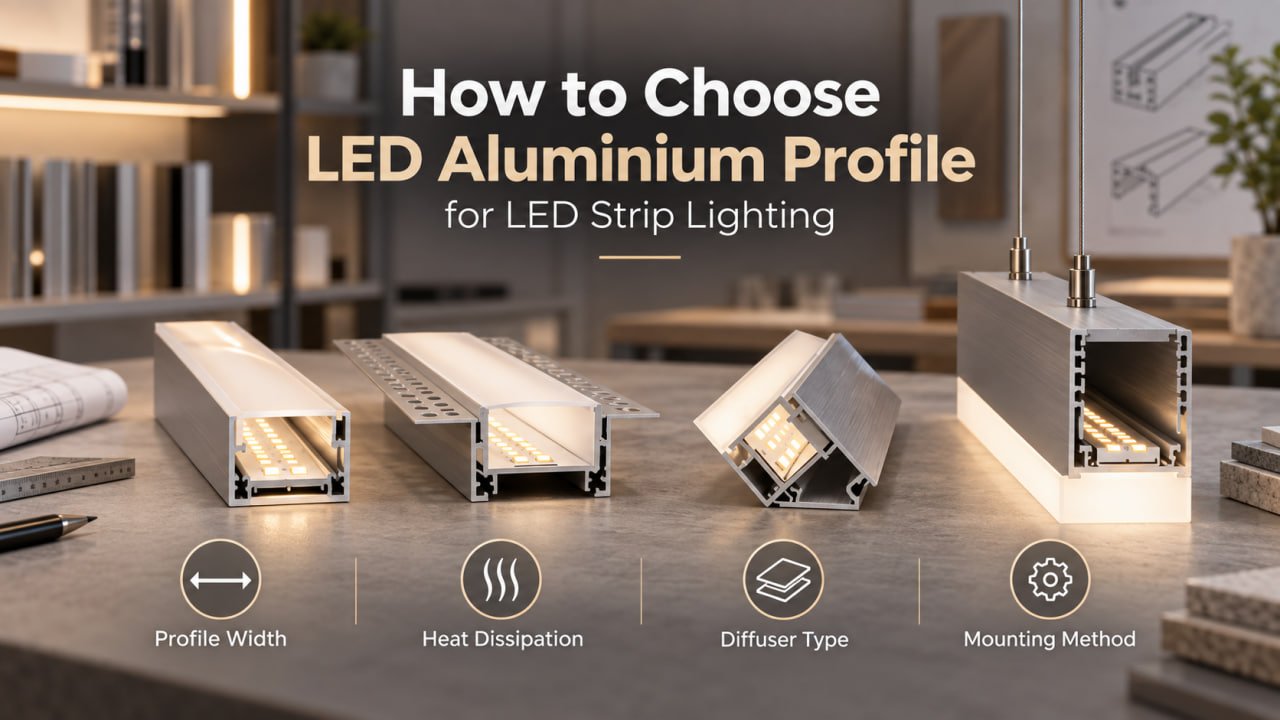
How to Choose LED Aluminium Profile for LED Strip Lighting
An LED aluminium profile does more than hide an LED strip. It becomes part of the thermal, optical and mechanical design of the lighting system. The wrong profile can create visible LED dots, poor heat dissipation, installation problems or a finished detail that does not match the architectural intent.
Before selecting a profile, confirm four things: the LED strip dimensions, power per metre, required lighting effect and installation detail. Profile appearance should come after these technical checks.
Start with the LED Strip Width
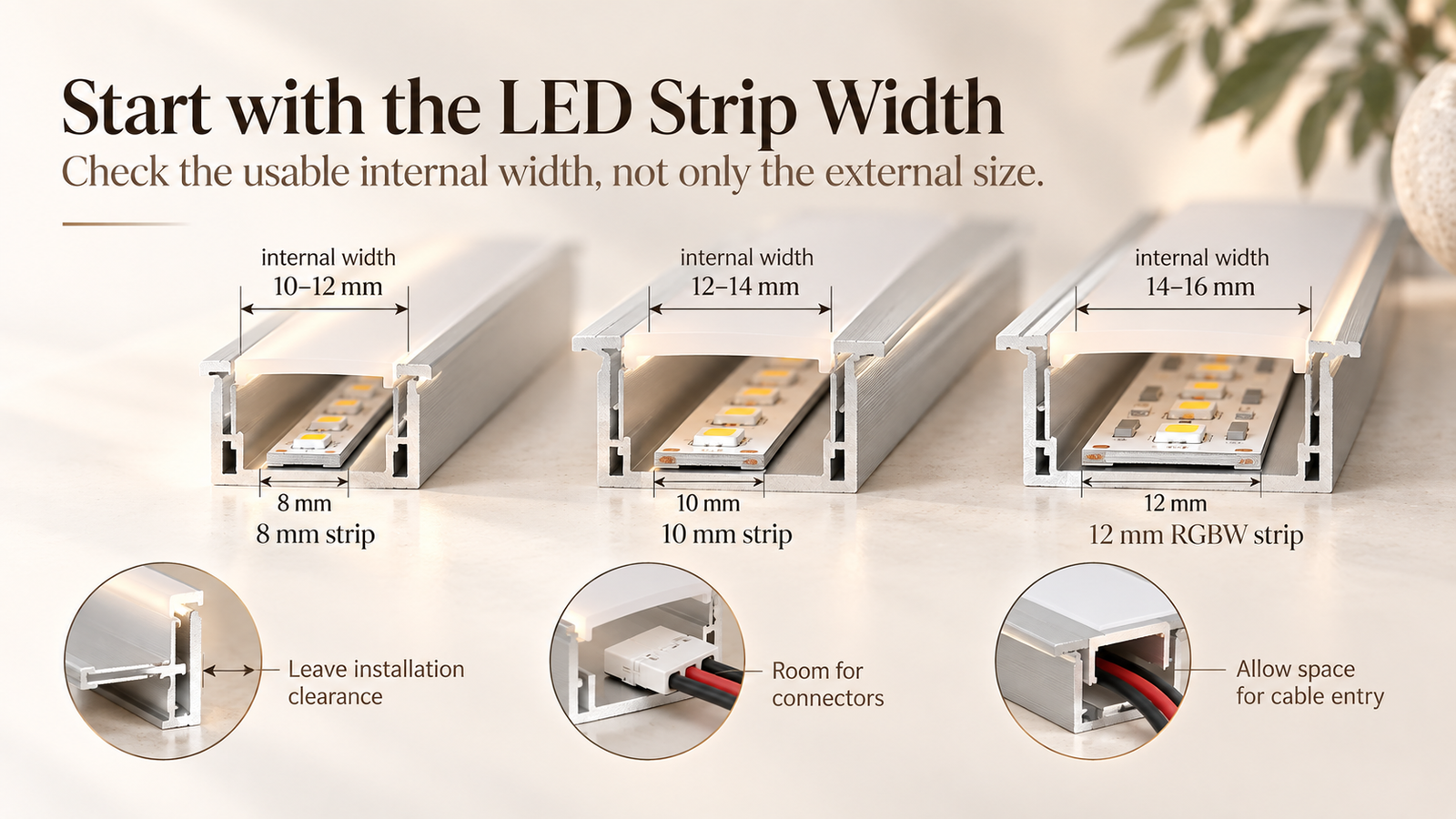
Internal profile width is the first dimension to check.
LED strips are commonly produced in several PCB widths, and the profile must have enough clear internal space for the strip, connectors and any soldered cable connections. A strip should not be forced against the profile walls.
Manufacturer profile ranges demonstrate why checking dimensions matters. LEDVANCE, for example, offers aluminium profiles with different internal and external dimensions for different LED strip systems rather than treating one channel as universally compatible.
For a 10 mm LED strip, therefore, do not specify a profile simply because its external width is 12 or 15 mm. Check the usable internal width shown on the technical drawing.
RGB, RGBW, tunable-white and higher-power strips can also be wider than standard single-colour LED tape, making this step particularly important.
Aluminium Size Should Match the Heat Load
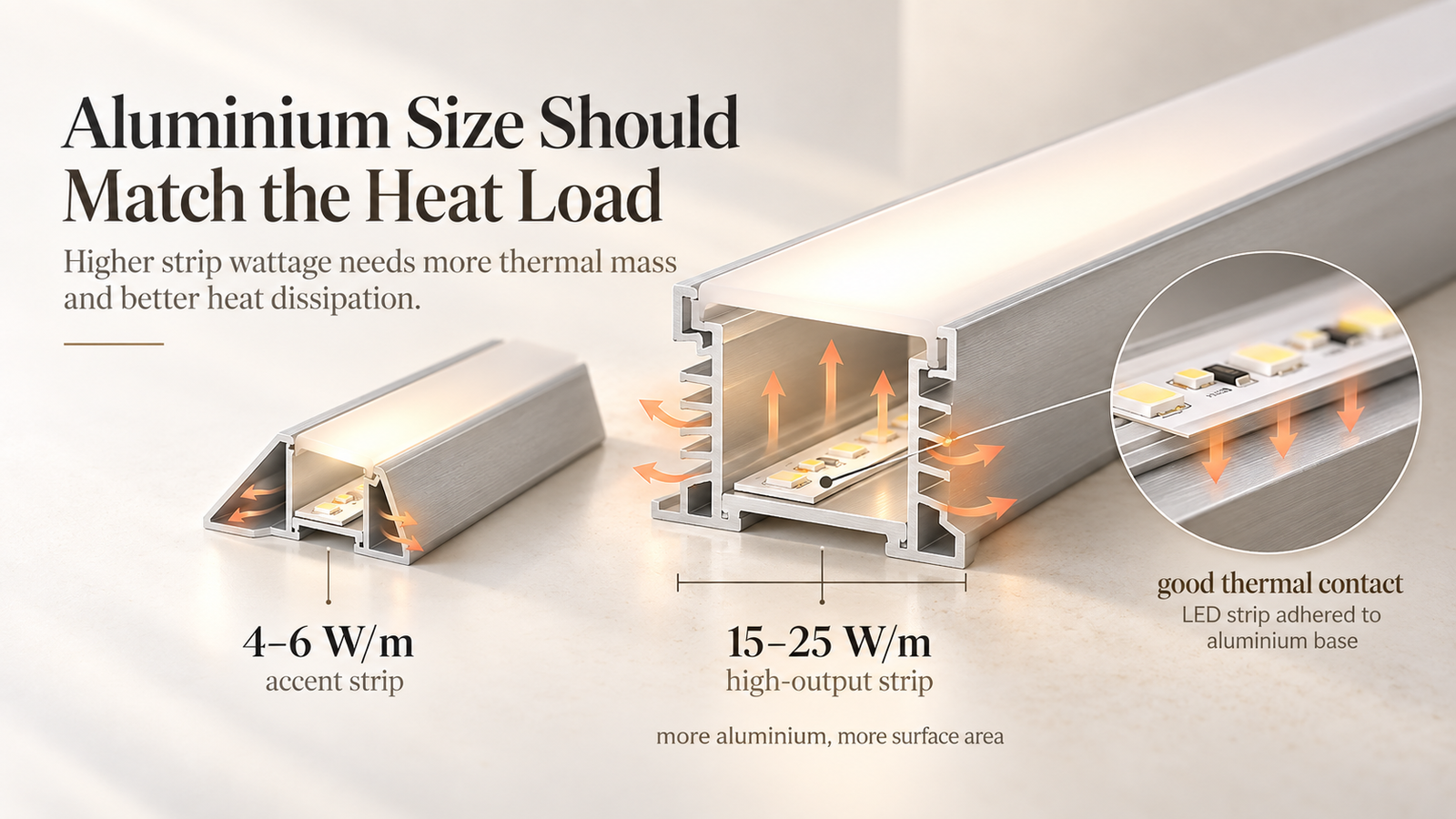
LED strips convert part of their electrical power into heat. Managing that heat affects LED operating temperature and, ultimately, performance and lifetime.
Aluminium is widely used for LED heat sinks because of its thermal conductivity and practical balance of weight, cost and manufacturability. Cree LED’s thermal-management guidance specifically identifies aluminium as a common heat-sink material and highlights the importance of transferring heat away from LEDs.
This means a very small decorative profile should not automatically be used with a high-output LED strip.
A 4–6 W/m accent strip has different thermal requirements from a 15, 20 or 25 W/m linear lighting system. As strip power increases, profile mass, surface area, installation surface and airflow become more relevant.
Also check how the strip contacts the aluminium base. Poor adhesion, uneven mounting or an insulating layer between the PCB and aluminium can reduce useful heat transfer.
For higher-output systems, ask the strip or profile supplier for the recommended maximum LED strip wattage rather than selecting the extrusion by appearance alone.
Profile Depth Changes the Appearance of the Light
Two profiles with the same width can produce noticeably different light.
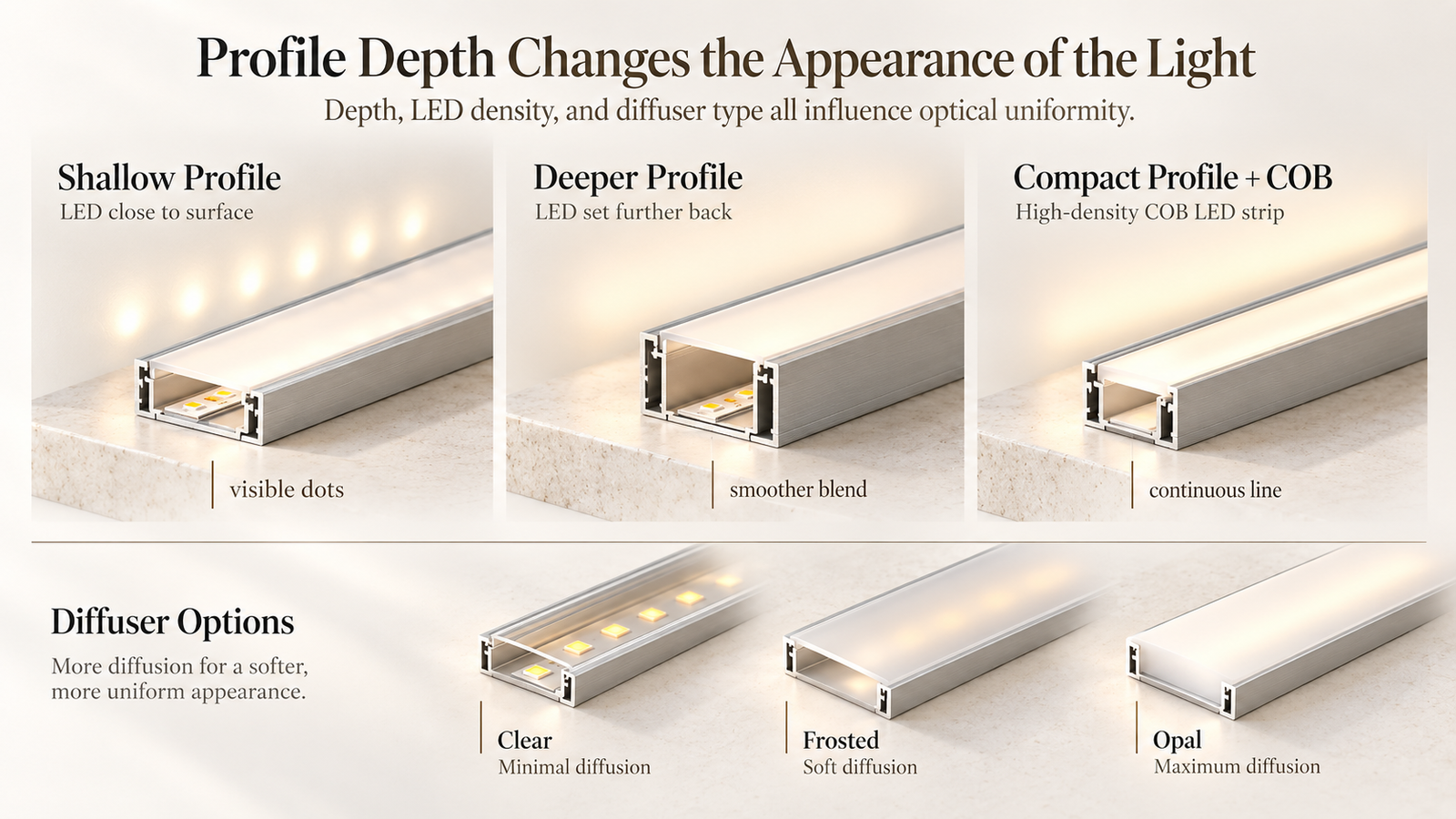
The distance between the LED chips and diffuser affects how well individual points blend together. A deeper profile generally provides more mixing distance before the light reaches the diffuser. Shallow profiles keep the installation compact, but LED points can become more noticeable when conventional SMD strips with relatively large LED spacing are used.
LED density must therefore be considered together with profile depth.
COB LED strips usually produce a more continuous luminous line and can work well where the profile needs to remain compact. Conventional SMD strips may require greater profile depth, higher LED density or a stronger diffusing cover to achieve a similar visual result.
Do not evaluate this only while looking directly at a 30 cm sample. A continuous five- or ten-metre illuminated line can reveal spotting and brightness inconsistencies much more clearly.
Clear, Frosted or Opal Diffuser?
The diffuser affects both appearance and delivered light.
A clear cover provides less diffusion and keeps more of the original LED intensity, but individual LEDs are more likely to remain visible. Frosted or opal covers mix the light more effectively and create a cleaner luminous line, although additional diffusion normally comes with some reduction in transmitted light.
LEDVANCE profile systems, for example, offer both clear and diffuse covers, illustrating that the cover is an optical choice rather than simply a protective accessory.
For indirect cove lighting where the LEDs are completely hidden, maximum diffusion may not be necessary. For a visible linear pendant, shelf light or recessed ceiling line, optical uniformity normally deserves more attention.
The best way to specify the combination is to test the actual strip + profile + diffuser together.
Select the Mounting Type from the Architectural Detail
The installation method usually determines the profile family.
Surface-mounted profiles work well under cabinets, inside joinery, on shelves and in locations where cutting a recess is impractical.
Recessed profiles create a more integrated architectural finish. Their flange can conceal the edge of the cut-out, but the required recess dimensions must be coordinated with gypsum, woodwork or ceiling details before installation.
Corner profiles typically position the LED at an angle and are useful inside cabinets, display shelving and junctions between vertical and horizontal surfaces.
Suspended aluminium profiles can turn flexible LED strips into complete linear pendant luminaires. Some commercial profile systems are specifically designed or accessorised for suspended mounting.
The profile should therefore be selected during detailing, not after ceilings or joinery have already been manufactured.
Indoor and Outdoor Profiles Are Not the Same Decision
An aluminium extrusion alone should not be assumed to make an LED installation waterproof.
For bathrooms, exterior façades, landscape details or other exposed locations, verify the declared ingress protection of the complete assembled lighting system, including the LED strip, profile, diffuser, end caps, cable entries, connectors and sealing method.
This deserves extra attention in Dubai. High outdoor temperatures, periods of high humidity and dusty conditions can occur, making thermal performance and environmental protection relevant for exposed installations. UAE National Center of Meteorology bulletins regularly document high summer temperatures together with significant humidity in Dubai.
A profile that performs well inside an air-conditioned residential ceiling should not automatically be specified for an exterior architectural detail.
A Practical Selection Check
Before approving an LED aluminium profile, confirm:
- LED strip PCB width and the profile’s usable internal width
- strip power in watts per metre and the profile’s thermal capability
- LED density, profile depth and required level of diffusion
- surface, recessed, corner or suspended installation method
- environmental/IP requirements and access for future maintenance
Once these points are confirmed, finish, colour and profile shape can be selected to suit the architectural design.
The best LED aluminium profile is not necessarily the largest or most expensive extrusion. It is the profile that provides enough physical space, thermal capacity and optical depth for the LED strip while fitting the construction detail correctly.